
The Operator's Cognitive Budget
Alert fatigue isn't a feelings problem. It's an architecture problem.


It’s 2:17 AM.
The phone screen lights up the ceiling. Before you’re awake enough to read the alert, your body has already done its math: elevated heart rate, scanning for threat, the cortisol already moving. You’ve been here before. That’s the problem. You’ve been here so many times that the dread precedes the thought.
You unlock the screen. Your production agent fleet ran 4,100 tasks in eleven minutes. Expected rate: 200 per hour. Something triggered a retry loop. You have no idea what it automated while you were asleep.
That moment, the automatic dread before the read, is not an emotional response. It’s a budget item. And right now, yours is overdrawn.
The Budget Is Real
Cognitive load is not metaphorical. Decision fatigue is not a soft-skills concept. The research is consistent: the quality of human judgment degrades as a function of the number and intensity of prior decisions. Surgical residents. Parole judges. People at 2:17 AM reading a disk alert that means nothing.
The problem isn’t that the alert fired. The problem is that you can’t distinguish, at 2:17 AM with elevated cortisol, whether it matters.
When every alert demands the same response, the brain stops grading them. Reach for the phone. Assess the situation. Make a call. That sequence fires whether the event is P0 or a threshold you set three years ago and never revisited. The gradation disappears. High-severity and low-severity look identical from inside an interrupted sleep cycle.
That isn’t a discipline problem. It’s a design problem.
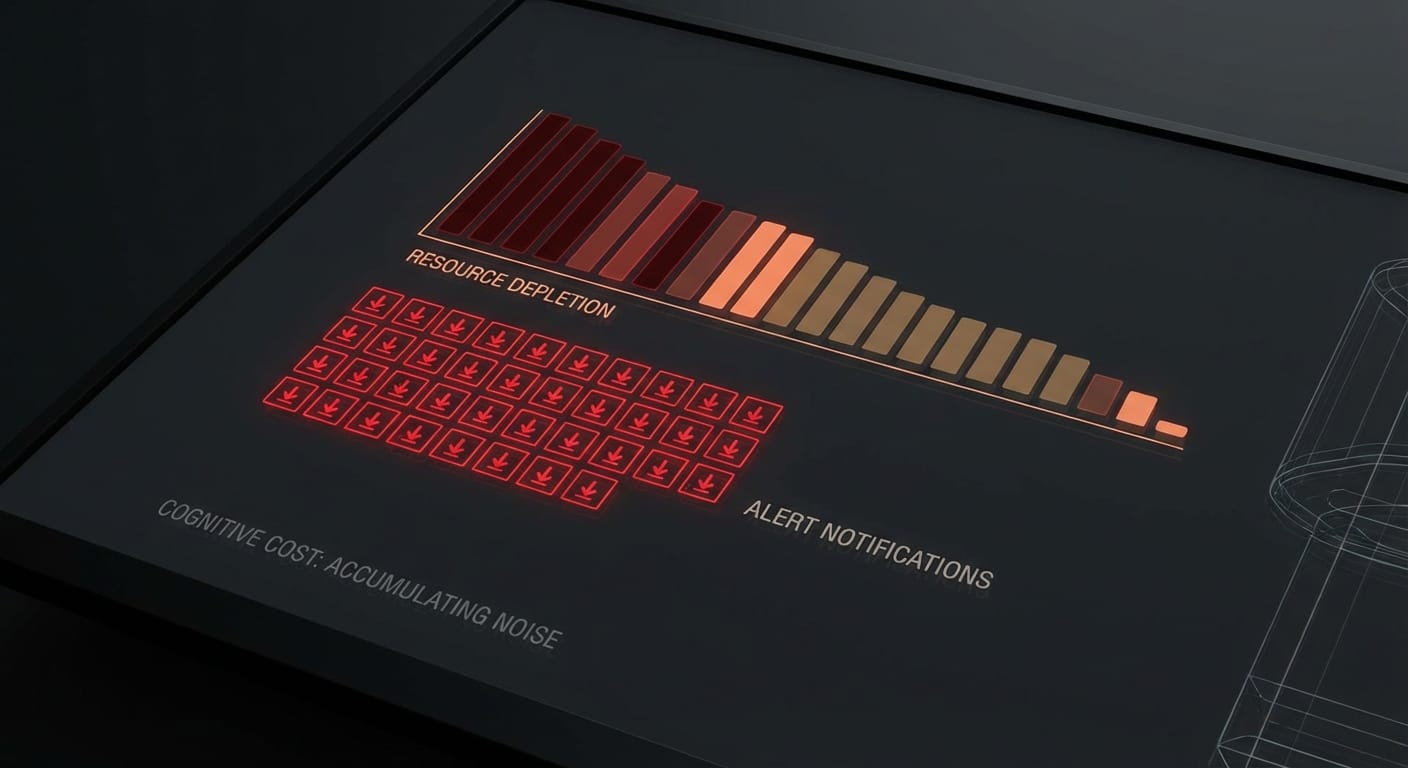
The cognitive budget is the total capacity for alert response, context-switching, and real-time judgment available in a given human in a given period. It’s finite, it’s exhausted by use, and it doesn’t reset at the start of the business day because the business decided that 24/7 coverage is a reliability goal.
Every alert path that fires unnecessarily withdraws from that budget. Every false positive. Every low-severity notification routed to a human instead of a log file. Every duplicate alert for the same underlying condition.
The tools aren’t paying this cost. You are.
How the System Steals the Budget
The failure mode isn’t a single noisy alert. It’s a system of small withdrawals that compounds into something that looks, from the outside, like operator error.
Here’s the pattern:
You tune the alert threshold up. Noise drops. You sleep through two nights. Then something real fires above your new threshold and you miss it. You tune back down. Noise returns. You stop checking your phone before bed because you know it’s mostly noise. Then something real fires and you’re slow. The postmortem says “delayed detection.” The recommended action is better alerting.
The cycle tightens. The budget depletes faster. The real signal gets harder to find because the baseline is perpetually elevated.
This isn’t an attention span problem. It’s a feedback loop problem. The system was designed to minimize missed alerts. It was not designed to minimize cognitive cost per alert. Those aren’t the same optimization target, and treating them as equivalent is what creates on-call cultures that quietly destroy people.
A system optimized only for recall, catching every possible event, will produce a high-noise environment that degrades the human operator’s ability to act on any of those events. You can have perfect alert coverage and still have a team that functionally cannot respond.
Five Budget Rules
These aren’t best practices. They’re constraints. Treat them as architecture.
1. Every alert path must have an owner and an expiry. If no one can name who owns a given alert and under what conditions it should be removed, it’s infrastructure debt. Alert lists don’t naturally shrink. Audit them on a schedule or watch them grow indefinitely.
2. An alert that woke someone up and led to no action is a failed alert. Not a near-miss. Not “worth keeping in case.” A failed alert. If it fires three times and nobody acts, remove it or route it async. It isn’t protecting you. It’s training you to ignore your phone.
3. Severity tiers must map to actual response requirements. If your CRITICAL tier sometimes means “someone should look at this tomorrow,” your severity model is broken. CRITICAL means interrupting a sleeping human. If that isn’t what the event requires, it isn’t CRITICAL. Collapse the tiers until the labels mean something.
4. Alert on conditions, not events. Receiving five separate alerts for five symptoms of the same underlying failure isn’t five times as useful. It’s five times as expensive. The tools can group by condition. The configuration requires someone to decide that cognitive cost is an architectural concern, not an operator problem.
5. On-call rotation is a stopgap, not a solution. Spreading the load across more people reduces the per-person cost. It doesn’t reduce the system cost. If the alert volume is unsustainable for one person, rotating four people through it produces four degraded operators instead of one. Fix the volume first.
None of this fixes a fundamentally noisy system. Nothing does except removing noise. But these constraints create the conditions where a human can make a clear decision, because clear decisions require a brain that hasn’t been conditioned to dread its own tools.
The goal isn’t zero alerts. It’s alerts that cost less than the value they return. The human reading them is not a renewable resource. Design accordingly.
Subtract one alert path this week, or you are lying about reliability.
Resources
Alert Fatigue — Wikipedia - Overview of the clinical and operational research on alert overload, including documented cognitive effects.
Alarm Management — ISA-18.2 - The industrial standard for alarm system design. Written for process control but the cognitive load principles apply directly to software ops.
Improving On-call Fatigue — USENIX - Research-backed look at on-call stress physiology, pager fatigue, and what actually reduces it. February 2023.
Alert Fatigue — PagerDuty - PagerDuty’s overview of alert fatigue causes and mitigation. Self-interested source, but covers the operational mechanics clearly.